


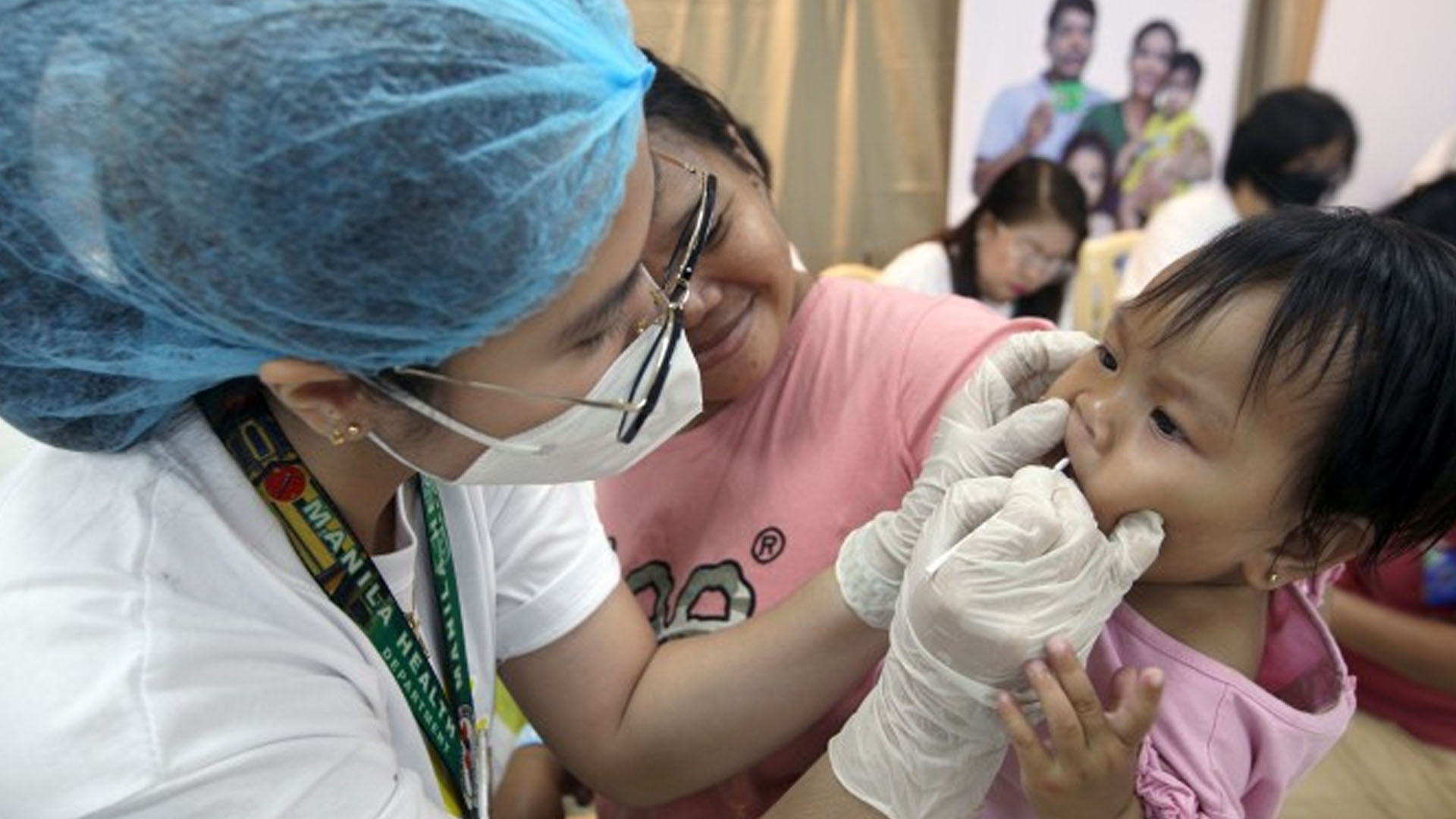








The Department of Health (DOH)-Cordillera said the “Purokalusugan” program established in the region to bring health programs closer to the people in far-flung communities is expected to address the low vaccination rate among children.
“We hope to address the low rate of accomplishment for the basic immunization through the Purokalusugan program, especially in far-flung communities and in geographically isolated and disadvantaged areas (GIDA),” said Joycelyn Rillorta, immunization focal person of the DOH-CAR during the Kapihan with CARE at the agency’s training center Wednesday.
Under “Purokalusugan,” health services are boosted with the hiring of more health workers to deliver the services to people who find it difficult to reach the health centers where these are usually provided.
She said that the country targets a 95 percent full immunization of children aged zero to 59 months.
“Coverage reached 59.72 percent against a year-end target of 95 percent, indicating a gap of 35.28 percent points below target,” Rillorta said.
Citing the latest data, she said the program’s performance is currently below the expected trajectory and requires intensified efforts to meet the goal.
The Cordillera’s five-year data showed that in 2021, the rate of fully immunized children reached 67.62 percent; 55.77 percent in 2022; 65.03 percent in 2023; 66.15 percent in 2024 and 59.72 percent in 2025.
Full immunization is defined as children aged zero to 12 months having received one dose of BCG (anti-tuberculosis); three doses of the pentavalent vaccine (against five major diseases); three doses of bivalent oral polio vaccine and two doses of MMR (measles, mumps and rubella) vaccine.
Completely immunized children are those who received the same vaccines when they reach their 23rd month.
She said that in 2025, fully immunized children logged 64.54 percent, while completely immunized children reached 5.48 percent, while there are 34.31 percent which have no coverage of the pentavalent vaccine that must have been received between ages zero to 12 months.
“Kailangan natin mahabol ang immunization ng mga bata para maiwasang magkaroon ng outbreak sa mga vaccine-preventable diseases (We need to catch up with the immunization of children to avoid an outbreak of vaccine-preventable diseases),” she added.
Rillorta said among the vaccines tagged as having a low immunization rate is MMR.
“While MMR immunization rate has been slowly increasing since 2021, this however, remains below the 95 percent target, steadily increasing the susceptible population. The growing immunity coincides with a marked rise in measles incidence since 2021. This number of susceptible and increasing measles transmission confirms a substantial and impending outbreak risk,” Rillorta said.
Records from the regional epidemiology and surveillance unit show that in 2024, there were 175 measles and rubella cases, with 17 of them laboratory confirmed, affecting mostly children aged 1 month old to 5 years old.
There were also cases involving adults aged 21 and 23 years old.
From Jan. 4 to April 4, the region recorded 27 cases of measles and rubella. A total of 161 cases were logged in 2025.
“We will be having the measles-rubella supplemental immunization activity to catch up on the unvaccinated children ages 6 to 59 months,” she said.
The region’s schedule for the ‘Ligtas Tigdas’ program is from Aug. 10 to 28, where children will also be provided with a Vitamin A supplement that further reduces the risks of complications due to measles. (PNA)