


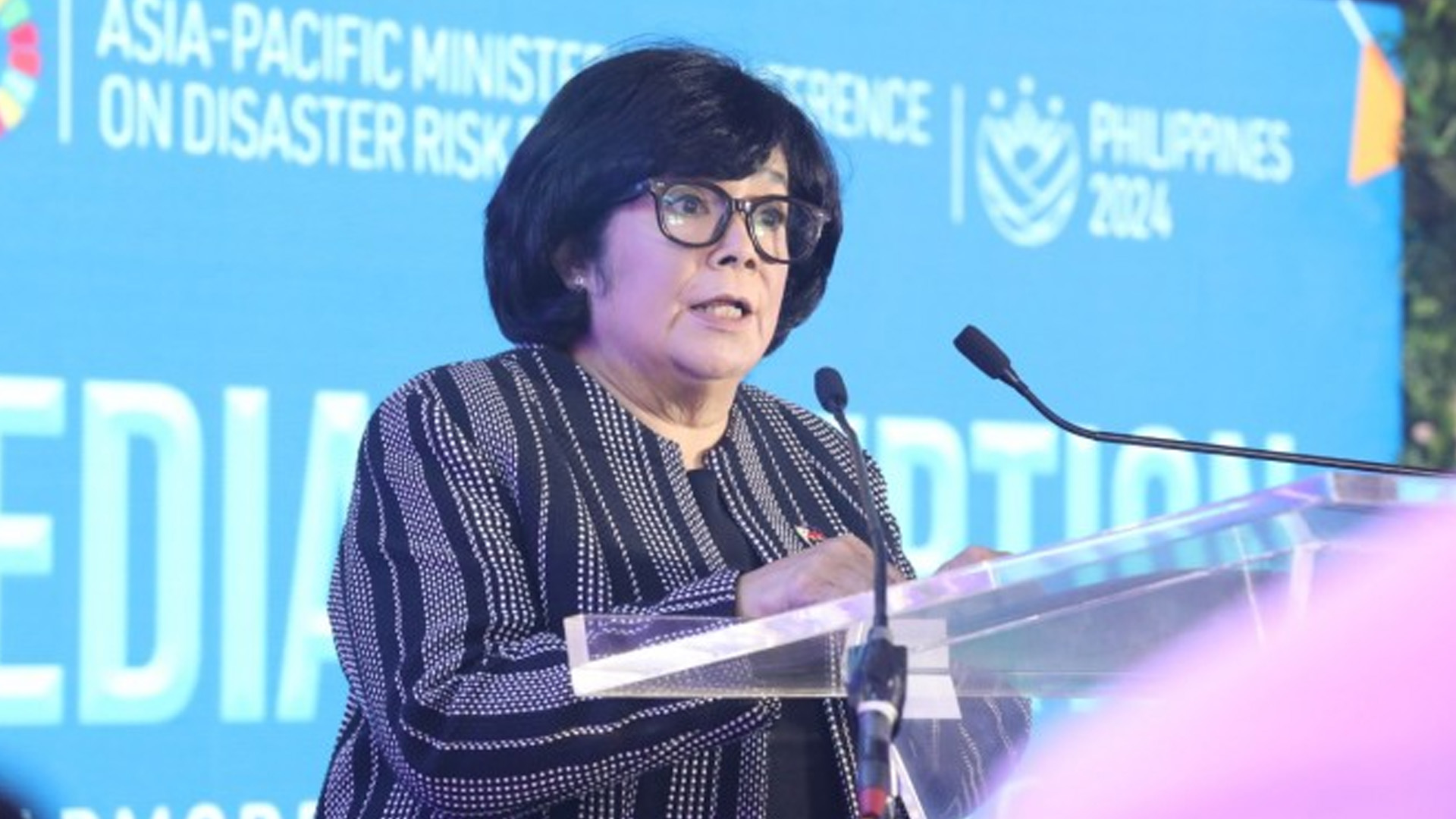








The Philippines will push for the localization of disaster risk management while developing the country’s early warning system by learning from other Asia Pacific countries, the Department of Environment and Natural Resources (DENR) said Monday.
On the first day of the Asia Pacific Ministerial Conference on Disaster Risk Reduction (APMCDRR) at the Philippine International Convention Center (PICC) in Pasay City, Environment Secretary Maria Antonia Yulo-Loyzaga said a single hazard is addressed in different ways because of the country’s varied geographies.
The Philippines, being the most prone to natural hazards in the world, is facing more disaster threats as these hazards become more intense due to climate change.
“So we need to be able to develop, number one, early warning systems that actually speak to the different contexts of our communities, it’s not just one warning. Secondly, we need to develop an understanding of what the warnings actually say,” Loyzaga said in an interview with the Philippine News Agency.
She explained that currently, most of the Philippines’ warnings are “based on the description of the hazard”, and that there is a need to contextualize these warnings for the people to understand the hazard they are facing.
Unfortunately, she said ordinary people, more often than not, do not really understand the danger of each disaster that hits the country, especially when the warnings are transmitted in a language that they cannot understand.
Meanwhile, Loyzaga cited the need to review the country’s plan for the ‘Big One’ or a massive earthquake.
The APMCDRR will take place in the country from Oct. 14 until Oct. 18, with about 4,000 delegates from various Asia Pacific countries, including the Philippines.
The conference brings together governments, intergovernmental, international, national, and civil society organizations, the private sector, science, academia, and stakeholder groups to accelerate progress in reducing disaster risk. (PNA)